


 Mohammad Ouhadi

1 min read
Do you really need to hire a fractional CFO before your series A?
 Evan Diaz de Arce
Real talk. The future is bleak for most startups. According to a recent Forbes study, approximately 90% of startups fail. That dismal number includes...
Running a startup's finances out of a spreadsheet makes sense early on. You know your burn, you know your revenue, and the model is simple enough to update yourself. That works until it doesn't.
Then a VC asks for a three-statement model. Or your burn surprises you mid-quarter. Or you realize your projections were built on assumptions that stopped matching the business six months ago. The spreadsheet stops being enough.
Hiring a full-time CFO feels like the obvious fix. At $250K or more in base salary, it's a commitment most seed-stage and early Series A companies aren't ready to make. Fractional CFO services fill that gap. You get a senior finance expert scoped to what your business needs right now, at a cost that fits where you are.
This guide breaks down what fractional CFO services cover, how the cost compares to a full-time hire, and how to know when it's time to bring one in.
Key takeaways

Finance titles get used interchangeably. Bookkeeper, controller, CFO, fractional CFO. They all sound like they handle money. The difference is what level they're operating at.
A bookkeeper records what already happened. Transactions get categorized, receipts get filed, statements get reconciled. Useful work, but it's backward-looking by design.
A fractional CFO starts where the bookkeeper stops. They take that historical data and build forward-looking plans from it: your financial model, your scenario analysis, your cash flow forecast, the KPI framework that tells you whether you're on track. That's the job.
A full-time CFO does the same work, but at a scale most early-stage startups don't need yet: managing a finance team, overseeing multiple systems, coordinating across departments at a $50M+ company.
If you're pre-Series A, a fractional CFO gets you the financial strategy without the executive overhead.

Startup financial modeling is the first place the spreadsheet breaks down. Revenue assumptions have changed. The cost structure is more complex. Investors are asking questions the model can't answer.
By the time most founders bring in a fractional CFO, the gap is already obvious. The starting point is usually a three-statement model: income statement, balance sheet, and cash flow statement, all connected so a change in one moves through the others automatically. From there, the model gets built around what actually drives your business.
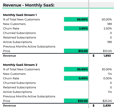
For SaaS companies, that means tracking CAC, LTV, churn, and payback period. These are the numbers investors use to decide whether your growth model holds at scale.
A fractional CFO connects those metrics to your financial model so the numbers tell a consistent story. If your CAC is rising, the model shows you exactly what that does to runway and margin.
Hiring two engineers next quarter moves your runway. A key enterprise deal slipping changes your cash position fast. Scenario planning shows you both outcomes before they catch you off guard.
A well-built startup financial model lets you run those scenarios before they become decisions you're making under pressure.
Hiring decisions are some of the most expensive commitments a startup makes. A fractional CFO builds out a headcount plan that shows the fully loaded cost of each role, the timing of cash outflows, and how each hire affects burn over the next 12 to 18 months.
Major equipment and infrastructure investments get mapped to timing the same way. No surprises when cash needs to move.
One of the most common mistakes founders make is treating the financial model like a pitch deck: built once, used for fundraising, then left untouched. A fractional CFO keeps the model updated with actual monthly results so it stays useful.
That feedback loop surfaces over-performance and under-performance early enough to act on it.

A full-time CFO hire runs $250K to $400K in base salary before you add equity, benefits, and recruiter fees that come with a months-long search. For most seed-stage companies, that's not a realistic line item.
Fractional CFO services typically run between $3,000 and $10,000 per month depending on scope and hours. You get senior-level financial expertise scoped to what your business needs right now.
The engagement is also flexible in a way a full-time hire isn't. You can bring in fractional help for a specific project: a fundraising model, a board presentation, a financial systems cleanup, then scale up or down as your needs change.
There's no recruiting fee, no onboarding period, and no equity premium. A fractional CFO starts contributing from the first engagement, and the monthly cost often pays for itself through a financial model that holds up in due diligence.

The signals usually show up before founders act on them.
If a Series A is on the horizon within the next 12 months, now is the time to engage fractional CFO services. Investors will dig into your startup financial modeling during diligence, and building a defensible financial story takes more lead time than most founders budget for.
When burn is hard to track across multiple cost centers, or when revenue timing is unpredictable, a basic spreadsheet stops being enough. A fractional CFO puts the right systems in place before cash flow surprises have a chance to become crises.
If you're going into a board meeting anxious about your numbers rather than confident in them, that's worth paying attention to. A fractional CFO prepares accurate reporting on a consistent cadence so you walk into those conversations prepared.
The decision usually comes down to a few honest questions about where your business is and where it's headed.
Is financial work eating more than 10 hours of your week? That time should be going into the business.
Do you need forward-looking strategy, or just accurate recordkeeping? If it's strategy, a bookkeeper won't cut it.
Are you planning to scale or raise in the next 6 months? If yes, the model needs to be investor-ready before you go to market.
Is your financial data scattered across systems with no unified story? That gap shows up fast in diligence.
If you're answering yes to most of these, fractional CFO services are worth the conversation. If your revenue is well past $10M and you need someone managing a finance team full time, a full-time hire makes more sense.

The spreadsheet that got you to this point won't get you through a Series A. Investors want to see a financial model that reflects how your business actually works, with assumptions grounded in data and a story they can follow.
Fractional CFO services give you that without the overhead of a full-time executive hire. You get senior financial expertise scoped to your stage, your model gets investor-ready, and you stop spending 10 hours a week on finance.
If your numbers need to be tighter before your next raise, Forecastr's fractional CFO services are built for exactly this stage. And if you want to see what a pro-level model looks like before you commit, grab our financial modeling templates to get started.

Subscribe on YouTube to get notified when we post new content
Get notified about new events, free resources, and fresh content

1 min read
Real talk. The future is bleak for most startups. According to a recent Forbes study, approximately 90% of startups fail. That dismal number includes...

1 min read
Early-stage finances are manageable. With just one spreadsheet and a few line items, there's nothing a sharp founder can't handle on their own. ...

1 min read
We admire entrepreneurs and anyone who’s out there trying to grow a small business. We love to see the passion, tenacity, and drive that founders...
 Mohammad Ouhadi