


 Logan Burchett

1 min read
Boost your startup's profit: a guide to unit economics
 Jeff Erickson
Unit economics is a key concept that shapes profit margins at the core of successful businesses. It’s more than just financial jargon; it’s a way to...
You've hit $1M+ ARR. Customers close fast, churn is low, and nobody's pushed back on price in months. That should feel like a win. It's often the first sign your SaaS pricing strategy hasn't kept up with the business.
Pricing quietly becomes stale. You set it early, when you had no leverage and no data, and never touched it again. Meanwhile your product, your customer base, and your competitive position have all moved on.
This post walks through how to build a SaaS pricing strategy that actually fits where your business is today. We'll cover how to tell if you're underpriced, whether usage-based pricing fits your business, and how to model a price increase before you commit to one. We'll close with how to structure a three-tier lineup that converts.
Key takeaways
Underpricing is roughly twice as common among SaaS companies as overpricing, and it's harder to catch because it doesn't show up as lost deals.
A 1% price increase can lift operating profit by around 11% on average, and well-executed increases typically add only 1 to 3 points of churn.
Usage-based pricing keeps gaining ground, especially as AI features push vendors toward consumption components layered on top of seats.
What matters is what a price change does to your revenue, churn, and runway. That's a modeling question you can actually answer.
Three-tier pricing works because buyers gravitate to the middle option, but only if you've modeled which tier actually makes you the most money.

Underpricing shows up in SaaS about twice as often as overpricing, according to pricing research firm Price Intelligently. It's also the harder mistake to catch. Overpriced products lose deals, and lost deals get noticed fast. Underpriced products just quietly leave money on the table, month after month.
Run through this checklist. If more than one or two apply, you're probably underpriced.
Your win rate on new deals is high, and has stayed high for several quarters.
Churn is low, and customers rarely mention price when they cancel.
Prospects rarely negotiate or push back on your listed price.
You haven't touched your pricing since your first dozen customers signed on.
None of these are proof on their own. Together, they're a pattern. A board member or advisor may have already flagged it. Or maybe deals just close a little too easily, and that nagging feeling won't go away.
Either way, a hunch isn't a plan. The next two sections turn that hunch into a model you can act on.

Usage-based pricing charges customers for what they consume. Per-seat pricing charges for who's logged in. Most SaaS companies default to per-seat because it's simple to bill and forecast. But billing simplicity and value capture are two different things.
The real question is how each model behaves in a revenue forecast as your customer base scales. Per-seat revenue grows in lockstep with headcount at your customer accounts. That's predictable, but it caps your upside when a customer gets more value without adding people. Usage-based revenue tracks actual consumption instead, which better matches value delivered. It also adds real forecasting complexity: you're now projecting usage volume per account, a variable per-seat pricing never required.
|
Per-Seat |
Usage-Based |
|
|
Best fit |
Tools used daily by a fixed team |
Products with variable, spiky consumption |
|
Forecasting |
Simple: seats × price |
Requires usage volume assumptions per cohort |
|
Revenue ceiling |
Capped by headcount |
Scales with customer growth and usage |
|
Customer risk |
Feels fair regardless of usage |
Bills can spike unexpectedly, hurting trust |
OpenView's annual SaaS Benchmarks survey found that the share of software companies using some form of usage-based pricing rose from roughly 27% in 2021 to about 38% today. It's a structural shift in how software gets priced.
AI features complicate the per-seat model in a specific way. A single seat can now trigger wildly different costs, depending on how much a user runs the model. Consulting firm L.E.K. has tracked vendors responding to this by layering usage-based components, like credits or API calls, on top of existing seat pricing. That approach adds revenue capture without raising per-seat prices outright.
That hybrid approach lets you keep the predictability of seats while capturing more value from your heaviest users. It's also a preview of the modeling work in the next section: any usage component means forecasting a new variable beyond headcount.
Whether you raise prices, restructure tiers, or add usage-based components, the decision comes down to one tradeoff: revenue lift versus churn risk. McKinsey's long-running pricing research looked at average economics across thousands of companies. It found that a 1% price improvement lifts operating profit by roughly 11% on average, assuming volume holds steady. Compare that to a 1% increase in sales volume, which lifts profit by only about 3%. Price is a stronger lever than growth alone.
The catch is that volume rarely holds perfectly steady. Some customers will churn. The question is how much, and whether the math still favors you once you subtract that churn from the revenue gain.
Here's the basic math. Say you have 500 customers paying $200/month, for $100,000 in monthly recurring revenue. You raise prices 10%, to $220/month. If churn stays flat, you're now at $110,000 MRR, a clean $10,000 gain. Even a conservative estimate of 1 to 3 points of incremental churn from a well-communicated increase would cost you 5 to 15 customers. At $220/month, that's $1,100 to $3,300 in lost revenue. You're still net positive by a wide margin.
That's a simple example with one price point and one churn assumption.
Your real business has multiple plans, renewal timing, and a mix of monthly and annual contracts. Run the same math across a few churn scenarios and a few price points to see which combination protects your runway. Our guide to building a financial model covers how to structure that kind of scenario analysis, so you can watch the cash flow impact before you send a single price-change email.
Once the math checks out, how you roll out the increase matters almost as much as the number itself. Grandfathering existing customers at their current rate for a defined window tends to hold churn closer to that 1 to 3 point range. Migrate them to the new price at renewal. Surprise increases with no notice tend to push churn toward the higher end of that range, or past it.
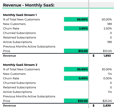
Our monthly SaaS financial model template is built to run exactly this kind of scenario. Use it to see how a price change plays out against your actual cash position before you commit.

Three-tier pricing works because of something researchers call the compromise effect. When people choose among three options, they tend to gravitate toward the middle one. It feels like the safe choice. It avoids both the risk of overpaying and the fear of getting the stripped-down version.
That's why your middle tier usually deserves the most design attention. It should include enough of your best features to feel like the obvious default. Just don't give away everything your top tier is meant to sell.
Here's the part most pricing advice skips: picking a "good, better, best" lineup by instinct isn't enough. Before you lock in a three-tier structure, model each tier's expected mix of customers, its revenue contribution, and its margin. A middle tier that converts the most customers isn't automatically your most profitable one. Factor in support costs, feature overhead, and how each tier's customers tend to expand over time.

Founders who model a price change before making it don't have to guess whether it will help or hurt growth. They've already seen the range of outcomes on their cash flow statement. That's what a real SaaS pricing strategy looks like: a decision backed by a model, made before the price-change email goes out.
Revisit pricing every time you close a major product gap, cross a pricing-relevant ARR milestone, or notice one of the underpricing signals from earlier creeping back in. Founders who treat pricing as a recurring model input catch the next round of underpricing months before a board member has to point it out.
Start with the checklist from the first section. Then run the actual numbers in our monthly SaaS financial model template before you touch a single price field. If you'd rather talk it through, schedule a demo with Forecastr and we'll model it with your actual numbers.

Subscribe on YouTube to get notified when we post new content
Get notified about new events, free resources, and fresh content

1 min read
Unit economics is a key concept that shapes profit margins at the core of successful businesses. It’s more than just financial jargon; it’s a way to...

1 min read
Do you know how investors predict the price of options with a good degree of accuracy? Enter the stage - the binomial option pricing model.

1 min read
Founders obsess over new customers. That makes sense. Growth is exciting. But focusing only on acquisition leaves a major blind spot. Without knowing...
 Evan Diaz de Arce
 Logan Burchett