


 Jeff Erickson

1 min read
Startup funding stages explained: from pre-seed to Series A round and beyond
 Logan Burchett
Most founders walk into their first investor meeting with a strong product and a compelling vision. What catches them off guard is that investors...
Seed-stage investors bet on the idea and the team. Series A investors bet on the machine. That shift changes everything about how you need to show up.
When you walk into a series A funding meeting, VCs are not looking for proof of concept. They want two to three years of clean financials, a model that holds up when they start pulling on the numbers, and data that tells a consistent story across every document in your data room. The bar is higher, the diligence is deeper, and the margin for “we’ll clean that up later” is essentially zero.
At this stage, most founders have some financial infrastructure in place, maybe a bookkeeper or a part-time controller. There is no $250K/year CFO on payroll yet, and figuring out what investor readiness actually looks like at this level can feel like a moving target.
The good news: you do not need a full finance team to get raise-ready. You need the right checklist, the right support, and enough runway in your calendar to do the work before your first meeting. This guide gives you exactly that.
Key takeaways

The most common reason series A funding deals fall apart is not a bad pitch. It’s a diligence surprise. A founder can have a great meeting, get verbal interest, and then watch the deal stall because the data room revealed messy revenue recognition, an incomplete cap table, or a financial model that does not match what was presented on slide nine.
By the time diligence starts, it is too late to fix the fundamentals. That is why investor readiness has to be a six-month project, not a two-week sprint.
There is also a less obvious reason to prepare early: confidence. When you know your burn multiple cold, when you can walk through your LTV:CAC ratio without pulling up a spreadsheet, when you can answer a surprise question about your Q3 churn without flinching, that signals something to VCs. It tells them you are actually running the business.
Think of early prep as pre-flighting your startup before a long-haul flight. You want to find the fuel leak on the ground, not somewhere over the Atlantic while a partner is asking about your net revenue retention.
Warning: Do not wait until you receive a term sheet to organize your financial records. A messy data room gives investors leverage to renegotiate your valuation, and the delay eats into your runway while you wait for capital to close.

Series A funding investors expect your financials to meet institutional standards. That means moving past cash-basis bookkeeping and building systems that accurately reflect how your business actually works. Here is what that looks like in practice.
Transition to accrual-based accounting so your revenue recognition matches GAAP standards. Investors will look at two to three years of historical performance, and if the numbers do not tell a clean story, that becomes a conversation you do not want to have mid-diligence.
Connect your P&L, balance sheet, and cash flow statement so they all talk to each other. A fully integrated model shows investors your total financial picture and makes it much harder to poke holes in your projections during term sheet negotiations.
Pick one place where your LTV:CAC ratio, monthly churn, and magic number live, and make sure every number in your pitch deck traces back to it. Inconsistencies between your slides and your raw data are one of the fastest ways to lose credibility on a diligence call.
Model a base case, an upside case, and a survival case. Investors are not just evaluating your best-case outcome. They want to see that you have thought through what happens when growth slows, a customer churns earlier than expected, or hiring takes longer than planned.
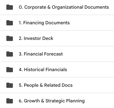
File your cap table, legal documents, financial reports, and IP assignments in a structured index so investors can find what they need without asking for it. A well-organized data room tells investors a lot about how you run the business day to day.
Tip: Label folders clearly and build an index document as the first thing investors see when they open the data room. It sounds small, but it makes a real difference.

Six months sounds like a long runway. It goes fast. Here is how to use it.
This phase is all about the past. Finalize tax filings, categorize historical spend correctly, and audit your cap table to confirm ownership percentages are accurate. Every SAFE and convertible note should be fully documented with conversion math that is agreed upon by all parties. Skeletons do not stay in closets once diligence starts. Find them now.
This is where you build your forward-looking financial model and push on every assumption. Your hiring plan needs to match your revenue projections. Your use of funds needs to map to specific growth milestones. If your model only works under perfect conditions, investors will find that out before you do.
Run your scenario cases, check whether your growth rate assumptions are defensible, and make sure the story your model tells matches the story in your deck.
Before your first investor meeting, have someone poke holes in everything. A fractional CFO, a mentor who has been through a series A funding round, or an advisor with VC experience can find the gaps you are too close to see.
This phase is about tightening the narrative and making sure every claim you make in a meeting is backed by something in your data room.

No CFO on payroll does not mean you have to do this alone. The modern startup ecosystem has options.
Specialized software. Move past manual spreadsheets to modeling platforms built for this exact process. Automated tools reduce the risk of formula errors and make scenario testing far faster to run and update.
Professional-grade templates. VCs see hundreds of decks. Using frameworks built to their standards means you are less likely to show up missing something they consider baseline.
Fractional CFO support. A few hours per month with a seasoned finance professional who has seen dozens of series A funding rounds can save you from expensive mistakes. They can guide your model, handle complex investor questions, and sit beside you during term sheet negotiations. The cost is a fraction of a full-time hire. The value is not.
Investor readiness at the Series A level does not require a full finance department. It requires the right people in the right roles at the right time.
Momentum in a fundraise is fragile. Once you have a lead investor interested, the last thing you want is a delay that gives doubt time to grow. These are the gaps that most often stall deals at the finish line.
Inconsistency between the pitch deck and the financial model. If the numbers in your slides do not match what is in your model, investors notice. It raises questions about how well you understand your own business.
A vague use of funds. “We’ll use the capital to grow” is not a plan. Investors want a specific breakdown of how the money gets deployed, what milestones it buys, and what the next raise looks like on the other side.
Cap table and legal issues. Missing IP assignments, unresolved founder equity disputes, or undocumented SAFEs can bring diligence to a full stop. These are fixable problems, but only if you find them before an investor’s lawyer does.

The founders who close series A funding rounds cleanly are not necessarily the ones with the best product or the highest ARR. They are the ones who showed up prepared. Clean books, a model that holds up under pressure, a data room that answers questions before they are asked, and a clear story that runs from the executive summary all the way through to the cap table.
That level of investor readiness does not require a full finance team. It requires a system, the right tools, and in most cases a seasoned finance professional who has been through this process before and knows exactly where the gaps tend to show up.
If you are six months out from your raise, now is the right time to start. Three months out, you are not too late, but you need to move. Either way, the next step is the same: get your model tight and your data room in order before an investor asks for it. Our fractional CFOs can help you build both, and our investor-ready data room template is a good place to start if you want to get your files organized on your own first.

Subscribe on YouTube to get notified when we post new content
Get notified about new events, free resources, and fresh content

1 min read
Most founders walk into their first investor meeting with a strong product and a compelling vision. What catches them off guard is that investors...
.png)
1 min read
No moment is more critical in the growth of an early-stage startup than when the founders roll up their sleeves and begin the process of raising...

1 min read
Moving from Seed to Series A is the biggest vibe shift a founder will experience. Seed investors bet on the team and the vision. Series A investors...
 Steven Plappert
 Jeff Erickson