


 Logan Burchett

1 min read
5 reasons a bottom-up financial model is the best to forecast revenue
 Logan Burchett
In today’s fast-paced and dynamic startup ecosystem, it’s essential for founders to have a crystal clear understanding of their startup’s financial...
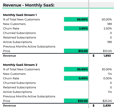
Before an investor decides to write a check, they’re going to look hard at how you make money. The SaaS revenue model behind your top-line number shapes your ARR quality, your churn profile, and the story your financial model tells.
When founders build their first SaaS product, they often focus on features. Pricing, however, becomes an afterthought. But when you’re in front of a VC, and they ask about your SaaS revenue model, you need to have a clear and confident answer that should be backed by real data.
The details matter, like whether you use annual or monthly billing. This simple choice can affect your valuation in ways many founders don’t expect. And it could be too late to change once the investor has already made up their mind.
This post explains the three most common SaaS pricing strategies. It also shows how each pricing model affects your business’ value. Finally, it helps you choose the right pricing model for your company and your fundraising goals.
Key takeaways

There are three pricing structures that most SaaS companies use. Each one produces a different kind of revenue and attracts a different kind of customer. It also sends a different signal to investors.
Annual contracts are a great way to ensure customer loyalty and boost your metrics. When a customer signs up for a 12-month commitment, it shows they believe in your product. This belief translates into better numbers.
You also get the benefit of collecting cash upfront. This helps fund growth and cuts down on the need for outside financing. Plus, you can recover your customer acquisition costs much faster. The longer commitment also gives you a full year to build a stronger relationship with the customer. This means there’s less pressure when it’s time for renewal.
When investors look at your business, one of the first things they check is whether you have annual or monthly contracts. A business with annual agreements looks more stable than one with month-to-month deals. Because this shows that customers trust your product enough to commit for a full year. And it’s a strong sign that your SaaS business is healthy and growing.
Monthly subscriptions make it easier for customers to try your product. They don’t have to commit to a full year right away, which is great when you’re still proving your product works. This is especially helpful during early customer acquisition, when you’re working on finding the right product-market fit.
The main tradeoff here is predictability. Monthly contracts make long-term forecasting harder because churn can occur at any time. If churn is high, it usually means customers aren’t seeing enough value. And investors will quickly notice that.
Most early SaaS companies start with this model, and that’s okay. Because the important part is knowing when to switch things up as your product grows and matures.
Watch out: A monthly SaaS revenue model can hide product issues. If customers are leaving after just one or two months, the real problem is retention, not pricing. It’s better to fix the product first before changing the pricing model.
Per-seat pricing means your revenue grows as your customer’s team grows. Every time they hire, your earnings increase without any extra spending on customer acquisition. This sets up a natural cycle of growth that investors really like. It’s especially great for tools that help teams collaborate, internal platforms, or anything that gets better the more people use it.
But, there’s one thing to watch out for: shared logins. This can be a big issue with per-seat models. To avoid problems, you need to make sure you set clear usage rules and price-per-seat limits in your contracts from the start.

Investors don’t just look at how much money a business makes. They also care about the quality of that revenue. For example, a business with $1M in annual contracts looks different from one with $1M in month-to-month plans. Even if both earn the same amount, they show different levels of stability.
The split between annual vs monthly revenue tells investors a lot. It shows how likely you are to lose customers. The more customers you have on annual contracts, the more stable your revenue looks. This can make your future projections look stronger during a business review.
Annual contracts help reduce the risk of losing customers. They also give investors a clearer picture of your future earnings. When you charge per user, it can show that your current customers are worth more over time. This is a strong indicator of success for SaaS companies.
Pro tip: Investors look for a negative net churn in your financial models. This means you’re growing your revenue from existing customers faster than you’re losing them. When your pricing is based on usage or per-seat, it’s easier to reach that goal.
You earn more money as your customers use your product more or add more seats. This leads to higher revenue, which can offset losses from customers who leave. This is a powerful sign for investors.
Sometimes blending models makes sense. For example, you could offer annual contracts to larger enterprise accounts with direct sales. At the same time, you might keep a monthly self-serve option for smaller teams. The important thing is that each pricing tier makes sense and is profitable.
If you’re not sure how your pricing structure is affecting your valuation story, that’s exactly what a financial model should help you see before you walk into a pitch meeting.

This is where a lot of SaaS founders run into trouble. Your revenue model and your sales motion need to match. If they don’t, the unit economics break down fast. For example, a $10/month product can’t support a complex, high-touch sales process. It just doesn’t add up. You’ll spend more on getting customers than you’ll ever make back.
Conversely, large enterprise clients typically expect yearly invoices, personalized onboarding, and continuous support. If your pricing model doesn’t offer these features, you may lose out on deals.
The practical question is simple: what does it cost you to acquire and serve a customer? And how long does it take to recover that cost? Your SaaS revenue model should be built around an honest answer to that question.
A self-serve, monthly plan works well when getting new customers is automated, and support costs are low. On the other hand, an annual plan with a direct sales approach works best when the contracts are big enough to cover the extra costs. So, getting this alignment right from the start makes your financial picture much clearer.

There’s no single right answer here. The best SaaS revenue model is the one that fits your customer, your sales motion, and your current stage. What works at the seed stage looks different from what works at Series B.
Here’s a straightforward process for working through it:
Start by understanding how your customers buy. Also, look at their budgets, how long they usually commit for, and how they’ve bought similar software in the past. For some businesses, a tiered pricing system may be better than a flat-rate model.
Build a financial model with each scenario. Input your customer acquisition cost and expected churn for each pricing approach. This will help you see which one gives you the longest runway and best unit economics.
Next, use Goal Seek to test your pricing assumptions. You can try adjusting your pricing variables to find the growth path with the strongest metrics. Small changes to the annual vs. monthly mix can make a big difference in your ARR quality and how investors view your model.
Once you’ve picked the best option, launch it and track the results. Because real data beats theory. We suggest you measure retention at 30, 60, and 90 days, and adjust your strategy based on what you learn.
It’s worth noting that many successful SaaS companies change their pricing model more than once before reaching an acquisition or IPO. That’s actually a sign of progress, not failure. It’s part of good product-market iteration.
What really matters is being able to explain why you chose your current model. When you talk to investors, you want to show what you’ve learned from it. And, of course, you need to explain where you’re headed next.

Your SaaS revenue model isn’t a detail to figure out after the product ships. It’s one of the core decisions that shapes your ARR quality, your fundraising story, and how long your runway actually lasts.
Monthly plans, yearly contracts, or per-seat pricing all have their place. It depends on your customer, your sales process, and your business stage. The main goal is to choose the one that makes your unit economics strong. Then build a financial model that shows investors exactly why it works.
Forecastr gives you free SaaS revenue model templates. That can help you try different pricing structures side by side. This way, you see what works best before you commit. It’s simple, fast, and stress-free. If you want extra help, you can book a demo. We’ll guide you step by step.

Subscribe on YouTube to get notified when we post new content
Get notified about new events, free resources, and fresh content

1 min read
In today’s fast-paced and dynamic startup ecosystem, it’s essential for founders to have a crystal clear understanding of their startup’s financial...

1 min read
Many founders build a financial model once, use it to raise money, and then file it away. That makes sense in the moment. But it creates a problem...

1 min read
You're staring at a blank spreadsheet, and the cursor is blinking back at you. An investor is waiting on your forecast, and you have no idea where to...