


 Logan Burchett

1 min read
Financial modeling prep: the critical gaps your P&L leaves exposed
 Jeff Erickson
A profitable income statement can feel like a green light. Your revenue is going up, margins look solid, and your accountant isn’t calling you with...
Financial modeling can feel like one of those topics that’s always just out of reach. You know it matters, but the deeper you go, the more complicated it gets. And when it comes to building a startup financial model, the learning curve can feel especially steep.
You're not alone in that. The financial modeling market is expected to reach $5.8 billion by 2032, which shows how many businesses are turning to these tools. But just because demand is growing doesn't make it easier to figure out. Between complex formulas, layers of assumptions, and startup metrics that all affect each other, it’s a lot to handle.
And that’s okay. Even seasoned finance professionals get tangled in complex spreadsheets. The issue here isn’t a lack of expertise; it's that financial models are genuinely complicated. Each part affects the others in ways that can be hard to follow.
The good news is that once you understand the basics, everything starts to make sense. In this article, we'll break down five financial modeling concepts that trip up even experienced founders, and show you how to get a handle on each one.
Key takeaways

If you’re building a startup financial model, then one of the biggest challenges that you can face is understanding how the three core financial statements work together. A lot of founders see the Income Statement, Balance Sheet, and Cash Flow Statement as separate things. But, in reality, they’re more like connected gears; when one moves, the others move with it.
You can think of it like a domino effect. One transaction can impact all three statements at once. For example, if you sell a product on credit, your revenue goes up on the Income Statement. But since you haven’t received the cash yet, Accounts Receivable increases on the Balance Sheet. The Cash Flow Statement shows that no cash came in, even though the sale took place.
Now let’s take the flip side. When a customer finally pays, the Accounts Receivable balance on the Balance Sheet decreases. At the same time, cash increases on the Cash Flow Statement. However, the Income Statement remains the same because the revenue has already been recorded. This timing difference can trip up founders. If you don’t account for it, your projected cash balance might not match reality.
This connection between the three statements is what makes financial planning accurate. It’s what keeps your projected cash balance reliable. When there’s a broken link between the Income Statement and the Balance Sheet, your startup financial model could fall apart. Every entry in one statement should lead to a change somewhere else.
So, what is the best way to check if everything is connected?
Change one input and follow the effect across all three statements. If something doesn’t change when it should, you’ve found a broken link. When the connections hold, your model tells a consistent and trustworthy story. That’s exactly what investors want to see.

Circular references are one of those concepts that can break a spreadsheet fast and frustrate even seasoned analysts in the process. This happens when a formula refers to itself, creating an endless loop. In startup financial models, this often happens with interest payments and cash balances.
Here’s how it plays out. You owe interest on your debt, which reduces your cash flow. If your cash balance drops too low, you may need to borrow more. This will increase your debt and, in turn, your interest payments. That added interest pulls cash down even further, which, as a result, triggers more borrowing. It’s a cycle that feeds itself.
Another common example is revolving credit. If your model uses a credit line when cash falls below a certain amount, the interest charged will reduce the cash, which could lead to another draw. Without the right setup, your spreadsheet might keep spinning in circles, just trying to figure out answers that never settle.
Excel and Google Sheets don’t handle this well by default. Without the right settings enabled, the spreadsheet can’t find a final answer. You’ll need to turn on iterative calculations so the spreadsheet can run the formula multiple times until the values stabilize. In Excel, you’ll find this under File > Options > Formulas > Enable Iterative Calculation. In Google Sheets, it’s under File > Settings > Calculation > Iterative Calculation.
A well-built startup financial model manages these loops cleanly, meaning it won’t crash the file or corrupt your data. If you’re building a model that includes any form of debt, a revolver, or interest-bearing instruments, expect circular references to show up. And knowing how to deal with them is key to making sure your model works well and doesn’t break.

Once you know the basics, the next most important thing that comes is a strong startup financial model. The key is understanding what drives your profits. One of the most important numbers to get right is gross margin. It shows the percentage of revenue you actually keep after paying for the direct costs of your product or service.
To figure this out, you need to start with an accurate view of your Cost of Goods Sold (COGS). This includes things like materials, direct labor, and any costs directly tied to making or delivering your product. It does not include operating costs like rent, marketing, or office salaries. And getting this classification right is very important. Because if you put a cost in the wrong place, your margin can look better or worse than it really is. A small mistake can give a misleading picture of your business.
Investors watch gross margin closely because it shows whether your product can grow profitably. For example, in a software company, hosting fees and infrastructure costs count as direct costs, so they are part of COGS. If these costs grow at the same pace as your revenue, your margin won’t improve. That makes covering fixed costs hard, no matter how much you sell.
That’s why your startup’s financial model should update gross margin as your production scales. As your business grows, some costs may rise, while others stay the same or even drop per unit. A good model shows these changes clearly, so you can track your margin in real time. It’s more useful than just a static snapshot.
This is very important for subscription-based businesses. A strong gross margin means that each new customer truly adds value to the business’s bottom line. A weak margin, however, can mean growth is costing more than it earns. And it is one of those startup metrics that often separates startups that scale from those that stall. For most SaaS companies, investors look for gross margins of 70–80% or higher. If your margin is below that, be ready to explain why. You also need to show how you plan to improve it.

The future is uncertain, which is exactly why a fixed financial model only gets you so far. Smart planning means preparing for different outcomes. Scenario analysis does that by testing "Best Case," "Base Case," and "Worst Case" projections so you know how your business holds up under pressure.
The examples are more practical than they might sound. What happens if revenue drops by 10%? How does a 30-day delay in cash collection affect your runway? What if you hire two extra engineers in Q2? A good startup financial model lets you answer these questions quickly, before they become expensive surprises.
The key is knowing which assumptions to stress-test. Not every input needs its own scenario. Focus on the levers that actually move the needle: customer growth, average deal size, churn, and hiring timelines. Changing the wrong variables gives you noise. Changing the right ones gives you clarity.
Scenarios also strengthen investor conversations. Showing a range of outcomes proves you've thought through the risks, not just the upside. It signals that you understand your business deeply enough to plan for what could go wrong, and that you're not just working from a best-case spreadsheet.
One important rule: keep your scenarios internally consistent. If revenue grows more slowly, marketing spend and hiring timelines should reflect that too. Adjusting one number in isolation produces a scenario that looks clean but tells a misleading story.
The structure of your startup financial model matters, but what drives it are the numbers you put in. These startup metrics tell investors whether your business has real traction or just potential. Get them wrong, and red flags appear fast. Four areas deserve your closest attention.

Burn rate tracks how fast your company spends its cash reserves.. Most startups lose their money at first, so tracking your monthly burn rate isn’t optional. It’s survival math. For example, if your burn rate is $50,000 per month and you have $500,000 in the bank, you have about 10 months of runway.
For a complete picture, calculate both gross burn (total cash out) and net burn (cash out minus cash in). Investors want to see both because they tell different stories about financial discipline.
One common mistake is confusing a temporary increase in spending with your regular monthly burn. For example, you might have paid for an annual software contract upfront or had a one-time recruiting push. Your startup financial model should smooth out those irregularities to show the real trend.
Also, don’t assume your burn rate will stay the same. As you hire more people, increase marketing, or expand operations, your cash consumption will naturally rise. Your model should reflect that reality, not assume a static spend level
Customer Acquisition Cost (CAC) shows how much you spend to get a new paying customer. The formula is simple: divide your total marketing and sales costs by the number of new customers gained. If your CAC exceeds what a customer brings in, you're losing money on every acquisition — and your model should be the first place that shows up.
But CAC alone doesn’t tell the full story. You also need to look at Lifetime Value (LTV), which is the total amount a customer will spend with you over their entire relationship. A good LTV-to-CAC ratio is around 3:1 or higher. This means your unit economics are working. For example, if it costs you $200 to get a customer, and that customer brings in $600 over time, you’re in a great spot.
Acquiring customers is only half the equation. Your churn rate tracks the percentage of customers who stop paying over a given period. High churn can quietly hurt even the fastest-growing company. It’s like trying to fill a bucket that has a hole in the bottom.
Your financial model should highlight how keeping customers longer boosts cash flow. Even a small drop in churn can lead to bigger revenue over time. In many cases, improving retention costs less than getting new customers. And investors know this, too.
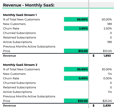
For SaaS companies, monthly recurring revenue (MRR) is a key metric. Unlike one-time sales, MRR helps you predict future earnings. Tracking MRR month over month shows whether your revenue base is actually compounding — or just treading water. Together, strong MRR growth and healthy retention give investors a reason to believe your growth is real and repeatable.

Mastering a startup financial model isn’t just about numbers or math; it's about understanding how your business actually works. Once you connect the dots between your financial statements and focus on the right startup metrics, like burn rate, CAC, LTV, churn, and MRR, you’ll gain control over your company’s direction.
Before sharing your model with anyone, review it and pressure-test your key metrics. Do your revenue predictions match the size of your target market? Are your growth assumptions based on real data? If your model shows capturing 50% of the market by year two, it’s time to double-check those assumptions. The more realistic your inputs, the stronger your business story will be.
The goal isn’t to predict everything perfectly. It’s about being ready for what could happen. Whether you’re preparing for a fundraising round or handling daily cash, a strong model gives you the confidence to make better choices.
Start with what you know, refine as you go, and let the model guide your decisions.
Want to create a financial model that tells your story? Schedule a demo with Forecastr. Our team will help you turn your numbers into a plan that investors can trust.

Subscribe on YouTube to get notified when we post new content
Get notified about new events, free resources, and fresh content

1 min read
A profitable income statement can feel like a green light. Your revenue is going up, margins look solid, and your accountant isn’t calling you with...

1 min read
Many founders build a financial model once, use it to raise money, and then file it away. That makes sense in the moment. But it creates a problem...

1 min read
Some founders don’t think about creating a startup financial model until it’s too late. It’s easy to do. You’ve got your nose to the grindstone,...
 Logan Burchett